
Bigul Mazdoor Dasta organized a talk and discussion at Earthcare Bookstore on the topic ‘Why the Four Labour Codes must be Resisted’.
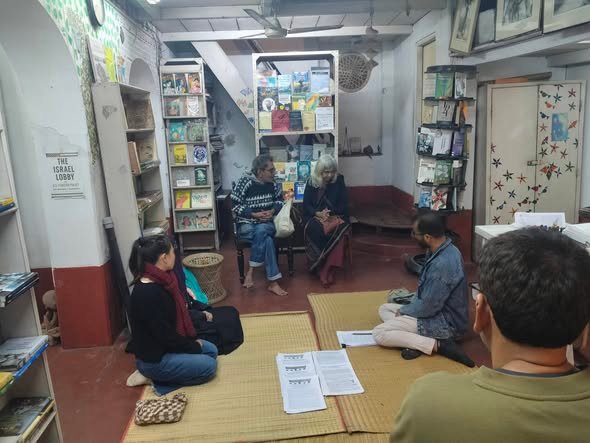 Criticising the Codes, Shishir situated them within the broader trajectory of neoliberal restructuring in India since 1991.
The central argument of the talk was that while the lives of informal and unorganised sector workers—who already face extreme insecurity—have been made even more precarious, the most decisive and dangerous attack is on the formal, organised sector working class. This section of workers historically possessed relatively stronger legal protections, union rights, and job security, and it is precisely these gains that the new Codes seek to dismantle. It was highlighted that any form of labour rights that the working class possessed had only been possible because of the uncountable sacrifices and the relentless struggle of the toiling masses.
The speaker explained that under earlier laws such as the Industrial Disputes Act, 1947, factories, mines, and plantations employing 100 or more workers were required to seek government permission before layoffs, retrenchment, or closure. The Industrial Relations Code raises this threshold to 300 workers and extends it across the organised sector, meaning that more than 80 percent of industrial establishments can now fire workers at will without oversight. Similarly, standing orders, which earlier applied to establishments with 100 or more workers and ensured transparency in service conditions, now apply only above 300 workers, allowing employers wide scope for arbitrary rules and dismissals.
He noted that labour courts at the district level are being replaced by a small number of tribunals at the state level, effectively denying workers practical access to legal remedies. Trade union rights have also been curtailed: whereas multiple unions could earlier negotiate and even unregistered unions had a role, the new law recognises only a “negotiating union” with 51 percent membership, an almost impossible condition in large workplaces, or a “negotiating council” of representatives from various unions if no one union has the requisite number of 51% membership, thus opening the door to employer manipulation.
The institutionalisation of fixed-term employment was described as one of the most dangerous provisions. Workers can now be legally hired for short durations, terminated without notice or retrenchment compensation, barred from strikes, and replaced continuously even when the work is permanent in nature. This transforms regular employment into legally sanctioned precarity within the organised sector itself.
At the same time, the speaker stressed that the informal and unorganised sectors have been further abandoned. Large sections of workers in agriculture, small establishments, construction, domestic work, brick kilns, power looms, hotels, IT services, and digital platforms remain outside meaningful coverage of social security, safety regulations, minimum wages, provident fund, and maternity benefits. Gig and platform workers continue to be treated as contractors, receiving only symbolic recognition and token welfare funds while being denied basic worker status and rights.
He also critically addressed the government’s claim that the Labour Codes “universalise” labour rights and social security. He argued that this universalisation exists only in official propaganda, not in material reality. One example discussed was how the Modi government has projected itself as progressive by allowing women to work night shifts in all sectors, while simultaneously weakening support systems by raising the threshold for mandatory crèche facilities from 30 women workers under the Factories Act to 50 women workers under the new Code, effectively excluding a vast number of women workers from childcare support. At the same time, maternity benefits have not been universalised and remain restricted to a narrow segment of formally employed women, leaving the overwhelming majority of working women in informal and contractual employment without protection. He further pointed out that provident fund coverage continues to apply only to establishments with 20 or more workers, excluding millions employed in small units, and that the Code on Wages does not even recognise gig and platform workers as workers, thereby denying them minimum wage protection altogether. These examples, he argued, expose how the language of universality is being used to mask systematic exclusion.
He also highlighted how safety and health protections have been hollowed out. The OSHW Code removes binding legal standards for working hours, hazardous processes, chemical exposure limits, safety committees, and safety officers, replacing them with government notifications and high thresholds that exclude the overwhelming majority of workplaces. Provisions introduced after the Bhopal gas disaster have effectively been dismantled.
Placing all this in political context, the speaker argued that the Four Labour Codes represent a transition from a statutory, rights-based labour regime to a system of discretionary governance where workers’ lives and livelihoods depend on executive decisions and employer convenience.
In the discussion that followed, participants elaborated on the nature of exploitation under capitalism, explaining how surplus value is extracted from workers through unpaid labour time and intensified productivity, while capital appropriates the wealth created collectively by labour. A participant stressed that as long as production is organised for profit, labour rights will remain fragile and reversible, and that their full realisation is impossible without a socialist transformation of society.
Participants also drew lessons from history, particularly from major working-class struggles such as the Mumbai textile workers’ strike of the 1980s, which demonstrated both the power of organised labour and the lengths to which the state and capital will go to defeat it.
Program concluded with a strong political call. The speaker argued that defensive protests and symbolic opposition are no longer sufficient. Given the scale of the attack embodied in the Labour Codes, he called for the entire working class—organised and unorganised, permanent and contractual, industrial and service sector—to unite for an indefinite nationwide strike to force the Modi government to repeal the Codes.
|
‘मज़दूर बिगुल’ की सदस्यता लें! वार्षिक सदस्यता - 125 रुपये पाँच वर्ष की सदस्यता - 625 रुपये आजीवन सदस्यता - 3000 रुपये ऑनलाइन भुगतान के अतिरिक्त आप सदस्यता राशि मनीआर्डर से भी भेज सकते हैं या सीधे बैंक खाते में जमा करा सकते हैं।
मनीऑर्डर के लिए पताः
मज़दूर बिगुल, द्वारा जनचेतना,
डी-68, निरालानगर, लखनऊ-226020
बैंक खाते का विवरणः Mazdoor Bigul
खाता संख्याः 0762002109003787,
IFSC: PUNB0185400
पंजाब नेशनल बैंक,
निशातगंज शाखा,
लखनऊ
|
आर्थिक सहयोग भी करें! प्रिय पाठको, आपको बताने की ज़रूरत नहीं है कि ‘मज़दूर बिगुल’ लगातार आर्थिक समस्या के बीच ही निकालना होता है और इसे जारी रखने के लिए हमें आपके सहयोग की ज़रूरत है। अगर आपको इस अख़बार का प्रकाशन ज़रूरी लगता है तो हम आपसे अपील करेंगे कि आप नीचे दिये गए बटन पर क्लिक करके सदस्यता के अतिरिक्त आर्थिक सहयोग भी करें।
मज़दूरों के महान नेता लेनिन |







Recent Comments